
BLOG BISIONA
Workflow in tendering: structure, control and operational efficiency
What does the workflow involve?
The concept of workflow as applied to tender management does not involve automating the preparation of the tender itself. The technical proposal, the analysis of evaluation criteria and the drafting of the distinctive sections will continue to require the input of experts, although there is scope for improvement and automation within these processes. What the workflow will automate is everything surrounding that work: the logistics of coordination.
How a structured workflow improves collaboration and efficiency in tender management
A structured workflow for preparing a tender works as follows:
- When the preparation phase begins, the system automatically assigns tasks to the managers of each department, with interim deadlines calculated based on the submission deadline.
- Each manager receives a notification containing a detailed description of what is required, the attached reference documents and the available deadline.
- The system tracks the status of each task and sends automatic reminders as deadlines approach or when a dependency is blocked.
- The tender manager has real-time visibility of the status of all pending contributions, without needing to actively check with each party.
- Documents are consolidated into a single repository with version control, eliminating the circulation of files via email.
The benefit of this model is not merely a saving of time. It also eliminates the risk of oversights, reduces the team’s operational stress and improves the quality of the bid: when the time previously spent on coordination is freed up, it can be devoted to reviewing and refining the content.
Automatic notifications: the glue that holds the process together
If the workflow is the framework, automatic notifications are the mechanism that keeps it running. In the context of tender management, relevant notifications operate at three different levels.
Trigger notifications
These are triggered when a new phase or sub-phase of the process begins. Their purpose is to ensure that all stakeholders know exactly what is expected of them and when, without the procurement manager having to communicate this manually in each instance. They eliminate the time spent on kick-off meetings and introductory emails.
Follow-up and alert notifications
These operate during the execution of each sub-phase. They alert managers when an interim deadline is approaching, when a task has been stalled for too long, or when a dependency is blocking another team’s work. They replace active, manual monitoring with a system that acts proactively.
Transition notifications
These are triggered when a sub-phase concludes and the next one is due to start. In tender management, transition points are particularly critical as they involve changes in personnel and departments. An automatic transition notification ensures that no one is left waiting for ‘someone to tell them’ and that the process proceeds without interruption.
We can also classify notifications by action, content or informative nature:
Notifications with associated content
These are notifications that, whilst informing the recipient, also send content: documentation required to complete certain stages, or generative content, such as the creation of a quote or a document based on templates, including those generated by artificial intelligence.
Action notifications
These notifications require the recipient to take a specific action. The most common is the notification of an offer’s approval, with or without escalation or parallel approvals. They are generally integrated with the corporate email system, and the traceability engine records the outcome of these actions for audit purposes.
Informative notifications
Their purpose is to keep those involved in the tender process informed about relevant events, dates and alerts, without requiring any specific action on their part.
What a workflow cannot replace
The automation of workflows and notifications has clear limitations that should be identified so as not to create false expectations.
No tool can replace the judgement required to analyse tender specifications and determine the bidding strategy. Nor can it replace the technical expertise of the team drafting the proposal, or the ability to assess whether the award criteria favour the company in a particular tender.
What automation does is free up time from this skilled work by eliminating everything that does not require it: reminders, follow-ups, document version management, the consolidation of contributions from different teams, and the communication of statuses and results.
A team that no longer spends time on manual coordination is better able to focus on what really sets a bid apart: the quality of the technical content and the precision of the response to the evaluation criteria.
Features that the workflow tools to be selected should have
Identifying the need to automate coordination is only the first step. The next decision, which tool to use for this purpose, has a direct impact on the actual return on investment and the implementation costs.
The key lies not only in the workflow functionalities themselves, but in the ability to integrate with the rest of the tendering process: document management, file tracking, competitor registration, deadline monitoring and, eventually, results analysis. A workflow that operates in isolation solves part of the problem, but requires maintaining multiple systems that are disconnected from one another.
Faced with this reality, organisations that actively manage tenders are usually faced with two distinct strategies:
|
Strategy 1: Generic workflow tool with integrations Select a general-purpose process automation platform and gradually integrate it with the other systems required for tender management: document repository, deadline manager, CRM or ERP. Pros: Flexibility to adapt to in-house processes, extensive ecosystem of connectors, potential to reuse the tool in other departments. Points to consider: Requires initial configuration and the design of specific workflows for tenders, as well as the maintenance of integrations with each external system. |
|
Strategy 2 Specialised tender management tool with built-in workflow Use a solution specifically designed to manage participation in public tender processes, which natively includes coordination workflows, document management, file tracking and the recording of results within a single environment. Pros: Workflows are already pre-configured for the tendering process, the learning curve is lower, and there is no need to design or maintain integrations between systems. Points to consider: Specialisation may mean less flexibility for very specific processes, so it is advisable to check the level of customisation the tool allows |
In either case, the criteria that should carry the most weight in the selection process are: the ability to configure workflows by tender type; full traceability of the process to enable continuous improvement; ease of adoption by teams that participate on an occasional basis, including an authorisation and permissions system that allows for the segregation of duties; and finally, integration with the data sources already used by the organisation, i.e. the ability to integrate the tool into the corporate application ecosystem in a simple yet robust manner.
There are three distinct tool profiles on the market, each with its own strengths and limitations. The following table allows for a comparison of the three profiles against the six key selection criteria:
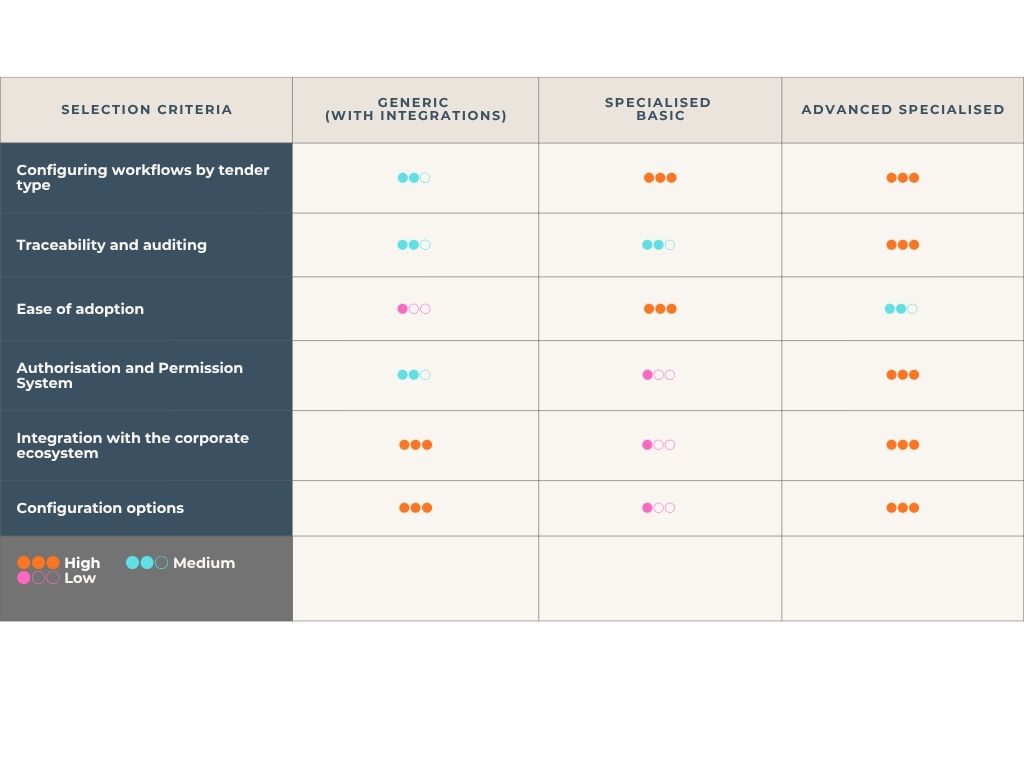
A review of the table suggests a practical conclusion: there is no single ‘best’ profile, but rather the most suitable one depending on each organisation’s starting point. For a company that already has the technological infrastructure and technical staff capable of configuring integrations, a generic tool may be a valid option. For most organisations actively involved in tendering processes but lacking such in-house technical expertise, the advanced specialised solution offers the most favourable balance between implementation time, functional coverage and adaptability.
In summary, participation management accounts for the largest proportion of time in the tendering process precisely because it combines technical complexity with a high degree of reliance on organisational coordination. The estimated 18.5 hours per tender are not distributed evenly: the tender preparation sub-phase accounts for more than half of the total and is where coordination challenges are most acute.
The implementation of structured workflows and automatic notifications between teams allows for the recovery of approximately 5 to 7 hours per tender in this phase, with a particularly significant impact on the preparation and opening sub-phases. For a company actively involved in tendering, handling 100 tenders a year, this cumulative saving can represent between 500 and 700 hours of recovered operational capacity.
También te podría interesar