
Artificial Intelligence: How to get the most of it
Without a doubt, Artificial Intelligence is making its way into Spanish companies, and its presence will continue to grow in the coming years. However, there are studies that show that the degree of satisfaction of companies with respect to the implementation of AI is not entirely satisfactory.
Thus, only 16% of the organizations that have integrated Artificial Intelligence into their processes consider that they are taking full advantage of this powerful tool.
These data do not question the importance of the implementation of AI in organizations and companies. Since the growing amount of unstructured information existing in the market and the massive volume of data, it is necessary for companies to equip themselves with tools capable of converting all this information into keys, insights and useful strategies that allow them to benefit from the data. that generate.

Artificial Intelligence in the Pharmaceutical Industry
The implementation of AI in the Health and Pharmaceutical sector brings with it numerous benefits and advantages for those organizations and laboratories that use it. Some of these advantages are:
Follow-up of the evolution of the patients
Optimizing the use of medicines
Generation of more successful strategies thanks to the predictive capacity of AI
That is why the need to integrate this type of technology in the current scenario is undeniable. But why do so many companies feel that they do not get a real benefit from this type of methodology?
The key to guaranteeing the success of AI in companies lies in the way in which this type of technology is implemented in companies and organizations. And it is that, for a correct integration of AI in organizations, 4 key phases are identified that must be followed:
First step
Analyze the systematization of decision making.
Second step
Once the systematization has been analyzed, the information is labeled. But only that which is relevant for decision making.
Third step
Thirdly, the different statistical algorithms are tested to choose those that are most suitable for the decision process that is carried out.
Fourth step
And, finally, the AI system must be allowed to learn to improve the results obtained.
BAIA: The new AI engine developed by BIsiona
BUSINESS ARTIFICIAL INTELLIGENCE ANGEL is the new set of models and methodologies proposed by BISIONA that combines different Artificial Intelligence and Data Science techniques. And that helps companies create more precise business strategies and improve sales performance thanks to the recommendations generated by the system.
How do we do it? Through the application of different statistical and Machine Learning algorithms that enable learning and the search for patterns of success. Thus, generating a differential, unique and real value proposition for each of our clients.
In addition, at BISIONA we are aware of how important it is to ensure the proper integration of this type of technology in each business. Adapting it to the specific needs and characteristics of each laboratory and company.
That is why the AI solutions we offer through baia are particular and specific, adapted to each business, product, pathology and objective.
Workflow in tendering: structure, control and operational efficiency
BLOG BISIONA What does the workflow involve? The concept of workflow as applied to tender management does not involve automating the preparation of the tender itself. The technical proposal, the analysis of evaluation criteria and the drafting of the distinctive...
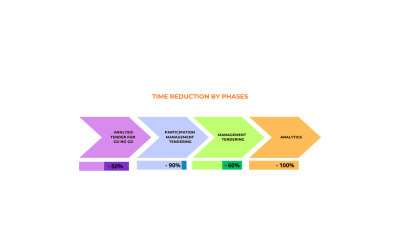
Managing participation in a tender: The set of processes that takes up the most time and offers the greatest potential for savings
BLOG BISIONA A structured overview of the process, the four main components that make it up, and the potential for optimisation that few organisations exploitWe have estimated an average of 18.5 hours of work, making this the most time-consuming stage of the process,...

Taking part in public tenders: What does it actually cost, and where is there room for improvement?
BLOG BISIONA A structured overview of the process, the four main components that make it up, and the potential for optimisation that few organisations exploitIf your company actively participates in public tenders, you probably feel that the process consumes a great...
Workflow in tendering: structure, control and operational efficiency
BLOG BISIONA What does the workflow involve? The concept of workflow as applied to tender management does not involve automating the preparation of the tender itself. The technical proposal, the analysis of evaluation criteria and the drafting of the distinctive...
Managing participation in a tender: The set of processes that takes up the most time and offers the greatest potential for savings
BLOG BISIONA A structured overview of the process, the four main components that make it up, and the potential for optimisation that few organisations exploitWe have estimated an average of 18.5 hours of work, making this the most time-consuming stage of the process,...