Managing participation in a tender: The set of processes that takes up the most time and offers the greatest potential for savings
A structured overview of the process, the four main components that make it up, and the potential for optimisation that few organisations exploit
We have estimated an average of 18.5 hours of work, making this the most time-consuming stage of the process, and also the one with the greatest potential for optimisation when analysed in detail.
Once again, it must be emphasised that we are talking about average times and that there are tenders where we have to spend much more time and others where we spend much less.
The reason for this weight is not solely the technical complexity of preparing a bid, although that is a factor. Rather, it is primarily the organisational complexity that accompanies this process, with the need to:
- Involve multiple departments operating at different paces.
- Consolidate scattered information.
- Pursue validations and approvals.
- Keep all stakeholders aligned under deadline pressure.
In this article, we break down the four sub-phases that make up this block, analyse where time is actually wasted, and explain how automated workflows and cross-team notification systems act as a catalyst and orchestrator for improvement and optimisation, cutting down on time and preventing errors.
The common denominator: the coordination that nobody sees
There is a pattern that warrants attention because it runs through the entire section: in virtually all the activities of this group, the need to exchange information with other departments arises in one form or another, such as “we need product documentation”, “we have to send samples”, or “the warranties need to be processed immediately”.
This exchange, seemingly routine, is in fact one of the main sources of inefficiency in tender management. Not because the information does not exist, but because of how it is usually managed: chain emails without a structured sequence or deadlines, shared documents with outdated versions, impromptu coordination meetings, manual reminders and dependencies that block progress until someone responds.
The result is that a significant proportion of the tender team’s time is not spent on preparing the bid, but on managing communication and following up on what others need to provide. It is time that goes unseen in tender processes, yet has a major economic and performance impact; it is recognised, but neither quantified nor addressed in any initiative.
Workflow and automated notification tools address this very inefficiency: they replace manual coordination with structured workflows, ensuring that everyone receives the information they need at the right time, thereby reducing the reliance on the tender manager and saving them time.
The four sub-phases of the block and their actual cost
Below, we analyse each of the sub-phases that make up the management of tender participation, including their estimated timelines, the activities involved, and the improvement measures that can be implemented in each.
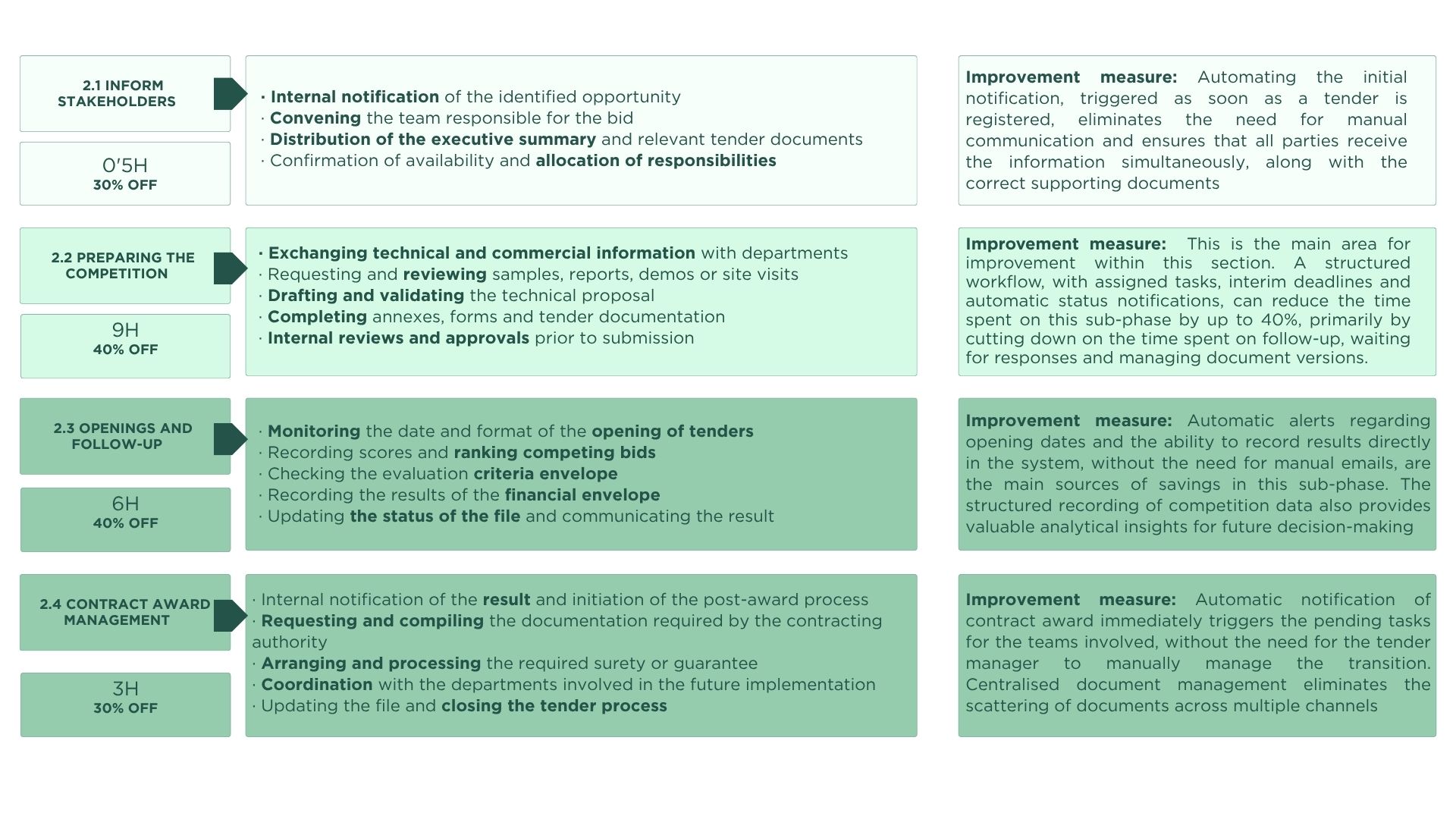
Summary of savings by sub-phase
The following table summarises the baseline time, the estimated percentage saving and the recoverable hours for each sub-phase 2 when an optimised approach using appropriate tools is applied:
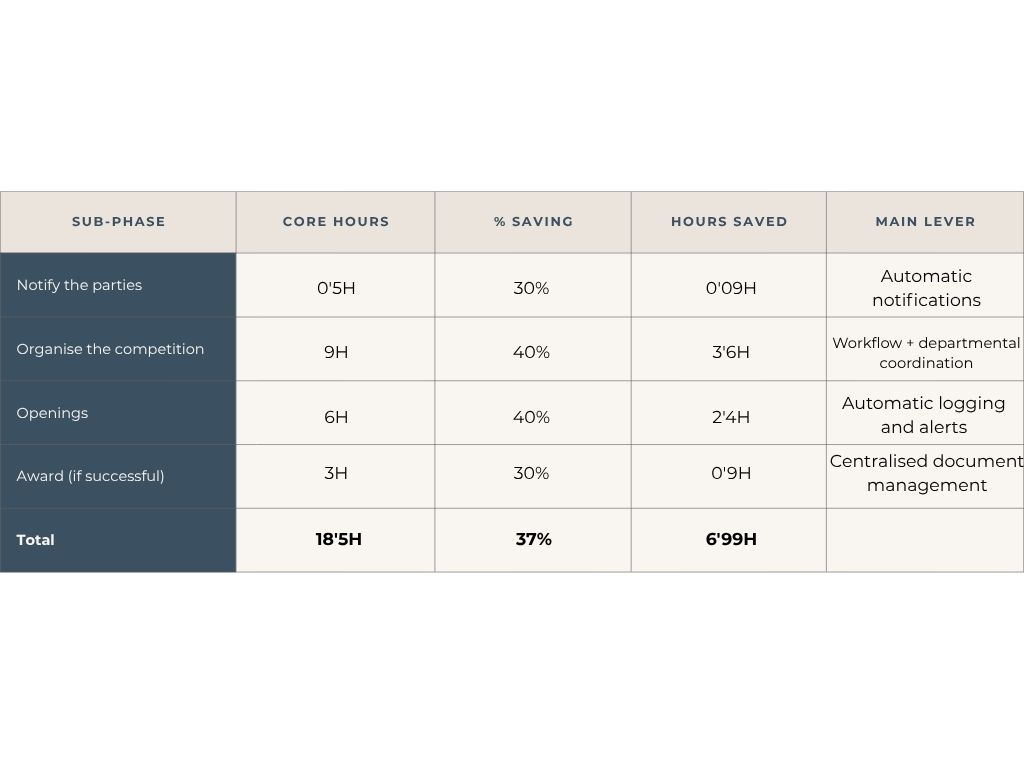
The total time saved amounts to around 6.99 hours per file, representing approximately 37% of the total time for the block. The bulk of this saving, over 80%, is concentrated in sub-phases 2.2 (Preparing the tender) and 2.3 (Bids), specifically in the recording of awards and scores.
Sub-phase 2.2 is precisely the longest and most dependent on coordination between teams.
And sub-phase 2.3 is the most tedious in terms of entering competition data and scoring criteria. This sub-phase is particularly time-consuming for companies tendering for supplies, where tenders involve many lots and competitors.
If we analyse where the effort is actually concentrated, it becomes clear that the tender preparation phase is not only the most time-consuming, but also the one most dependent on coordination between teams.
It is precisely at this stage that most inefficiencies arise: waiting times, manual follow-ups, lack of visibility and duplication in information management. And, at the same time, this is where the greatest potential for improvement lies.
In the following article, we will delve specifically into this key phase, exploring how a structured workflow enables the organisation of all internal coordination, reduces friction and transforms the way teams collaborate during the preparation of a bid.
We will examine, in a practical and detailed manner, how this model works and why it becomes a decisive factor in achieving greater efficiency and quality in tender management.
También te podría interesar